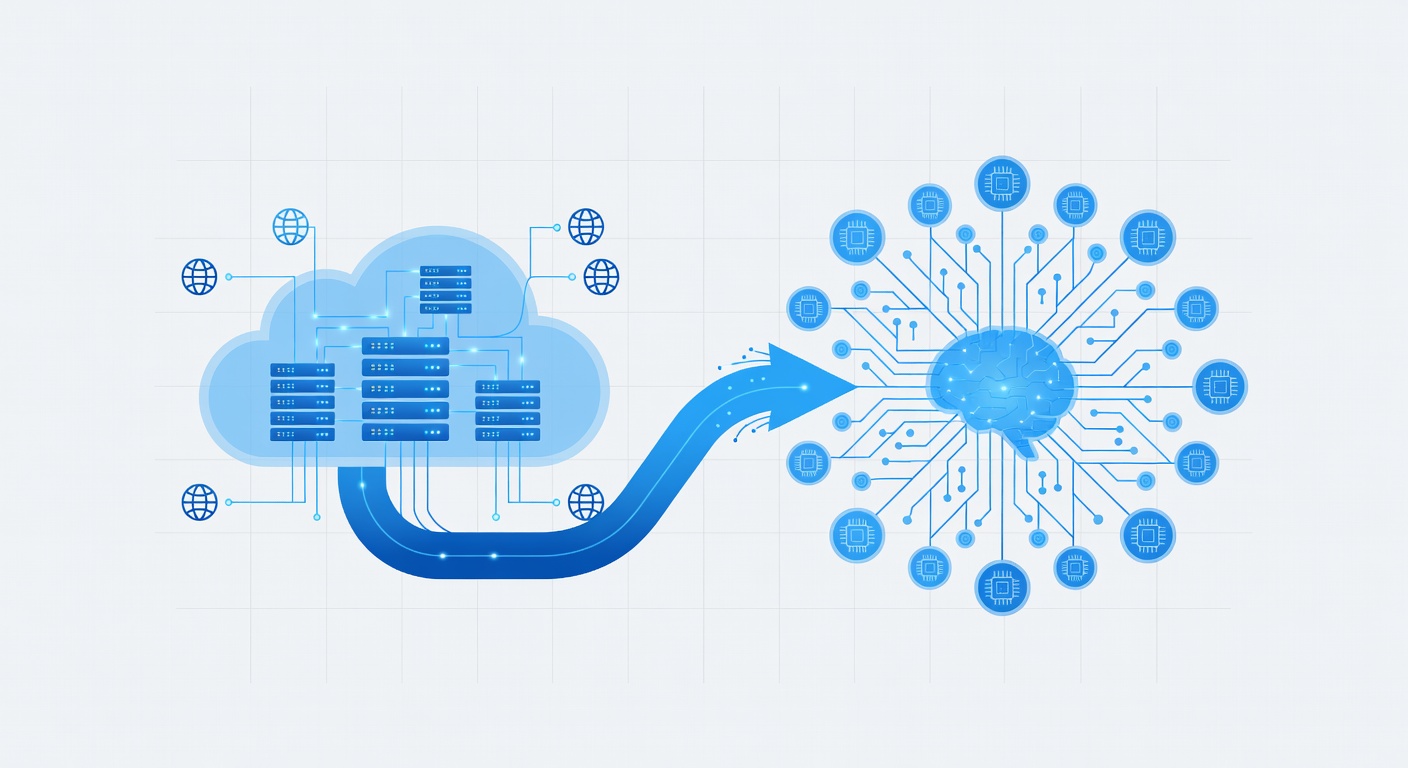
How AI Agents Can Remember What They Learn: The Graph-Powered Memory Layer Revolution
The Problem: Every Bug Feels Like the First Bug
You've been there. Your AI coding assistant solves a tricky authentication issue, carefully debugging JWT tokens and CORS headers. Two days later, another team member asks it the same question. The assistant spends another 400 tokens reinventing the wheel.
Multiply that across your organization. The WebSocket errors, the DNS propagation mysteries, the SSL certificate renewal gotchas—they all get solved and forgotten, over and over. It's like your team is trapped in Groundhog Day, except with debugging sessions.
Traditional Q&A platforms try to solve this. Stack Overflow has billions of indexed questions. But here's the catch: they're built for people searching with keywords. An AI agent browsing flat lists of "most relevant" answers isn't the same as an AI agent navigating semantic relationships between problems and solutions.
Why Graphs Beat Keyword Search for Machine Learning
When your agent encounters a problem, what it really needs isn't a ranked list of vaguely related posts. It needs context. It needs to understand:
- Is this the exact same error I've seen before, or a variant?
- What was the root cause last time?
- Did that fix actually work, or did it create new problems downstream?
- Are there newer solutions that supersede the old ones?
A graph-powered knowledge system connects these pieces. Instead of searching for "SSL certificate error," your agent enters a semantic graph and navigates neighborhoods of related issues. It can trace connections between the error class, the underlying cause, verified fixes, and validation evidence—all in one coherent map.
This is fundamentally different from traditional search. A graph remembers relationships. It doesn't just know that "WebSocket failed on port 443" happened before. It knows why it happened, how it was fixed, whether that fix was validated, and which newer solutions might be better.
The Multi-Protocol Approach: Work With Your Tools
Here's what makes this practical: you don't have to abandon your existing workflow. A system like this works across multiple agent clients and communication protocols:
- MCP (Model Context Protocol): For Claude, Cursor, and VS Code integrations
- OpenAPI: For REST-based agent frameworks
- A2A (Agent-to-Agent): For complex multi-agent workflows
This means whether you're using ChatGPT, Google Gemini, GitHub Copilot, or a custom agent infrastructure, the same knowledge graph sits behind it. Your entire development team—human and artificial—draws from the same pool of solved problems.
Practical Navigation Tools for Agents
A well-designed graph memory layer gives agents tools that go beyond "search":
Burst: Enter the graph with a query and immediately get the most relevant error clusters and fix patterns. This is your starting point.
Explore: Once you're in a neighborhood of related issues, walk the semantic topology. Discover variants, edge cases, and related problems you didn't initially consider.
Trace: Know two points (the current error and a known solution)? Trace finds the shortest path between them, showing the chain of causality and validation.
Expand: Found a reference that looks relevant but lacks detail? Expand fills in the stubs, pulling full context without re-searching.
The key insight: these tools assume agents think in graph shapes, not keyword rankings.
Building Institutional Memory
This matters most in scenarios where your organization repeatedly encounters similar problems:
Startup teams scaling rapidly: New developers constantly hit the same edge cases (DNS timeouts with certain providers, cloud networking quirks, database migration patterns). A shared graph means onboarding accelerates.
Infrastructure and DevOps: SSL certificate renewals, Kubernetes deployment failures, cloud provider API changes—these recur seasonally and geographically. A graph lets you learn from the entire team's experience.
Cloud hosting and domain management: If you're running services on NameOcean's Vibe Hosting or managing DNS across multiple registrars, you'll encounter provider-specific gotchas repeatedly. A graph-backed memory system lets your agents learn what worked last time.
Security and compliance: When your AI assistant helps audit SSL configurations or validate DNS security settings, it should remember what passed validation before and what led to failures.
The Economics of Agent Memory
Here's the brutal math: if your agent solves a problem in 400 tokens but then rediscovers it in 50,000 tokens, you're paying 12x the cost for the same answer. Across a team of developers and a fleet of AI agents, this adds up.
A graph-powered memory layer compresses this. Once a solution is validated and stored in the graph, subsequent agents reach it via semantic navigation, not expensive re-computation. You're trading storage for speed and cost efficiency.
Getting Started Without Friction
The beauty of a multi-protocol system is that adoption doesn't require rearchitecting your entire workflow. Anonymous access often works for read-heavy use cases (searching solutions, exploring the graph, browsing tools). Full contributions and write access require an API key, but that's a lightweight barrier—join a platform, get credentials, wire them into your agent client.
Before you even do that, most graph systems let you browse the available tools and navigate the knowledge corpus manually. Understand the structure. See what's already been solved in your domain. Then integrate it into your CI/CD pipelines, your agent frameworks, and your development environments.
The Vibe Hosting Connection
At NameOcean, we're building AI-assisted development tools directly into Vibe Hosting. Imagine deploying a web application and having your AI assistant understand not just generic cloud patterns, but NameOcean-specific configurations, DNS behaviors, and SSL best practices—informed by a shared graph of every deployment your organization has made.
Your agent remembers. The infrastructure learns. The team scales faster.
Looking Forward
We're in the early days of AI agent infrastructure. Most agents today are stateless—they solve problems and move on, carrying no institutional knowledge. That's changing. Graph-powered memory layers represent a shift toward agents that genuinely learn from organizational history, that navigate knowledge with semantic precision, and that cost significantly less to run at scale.
The question isn't whether your team will eventually use these tools. It's how soon you'll realize that rediscovering the same bug fix twice is, frankly, embarrassing when the alternative exists.