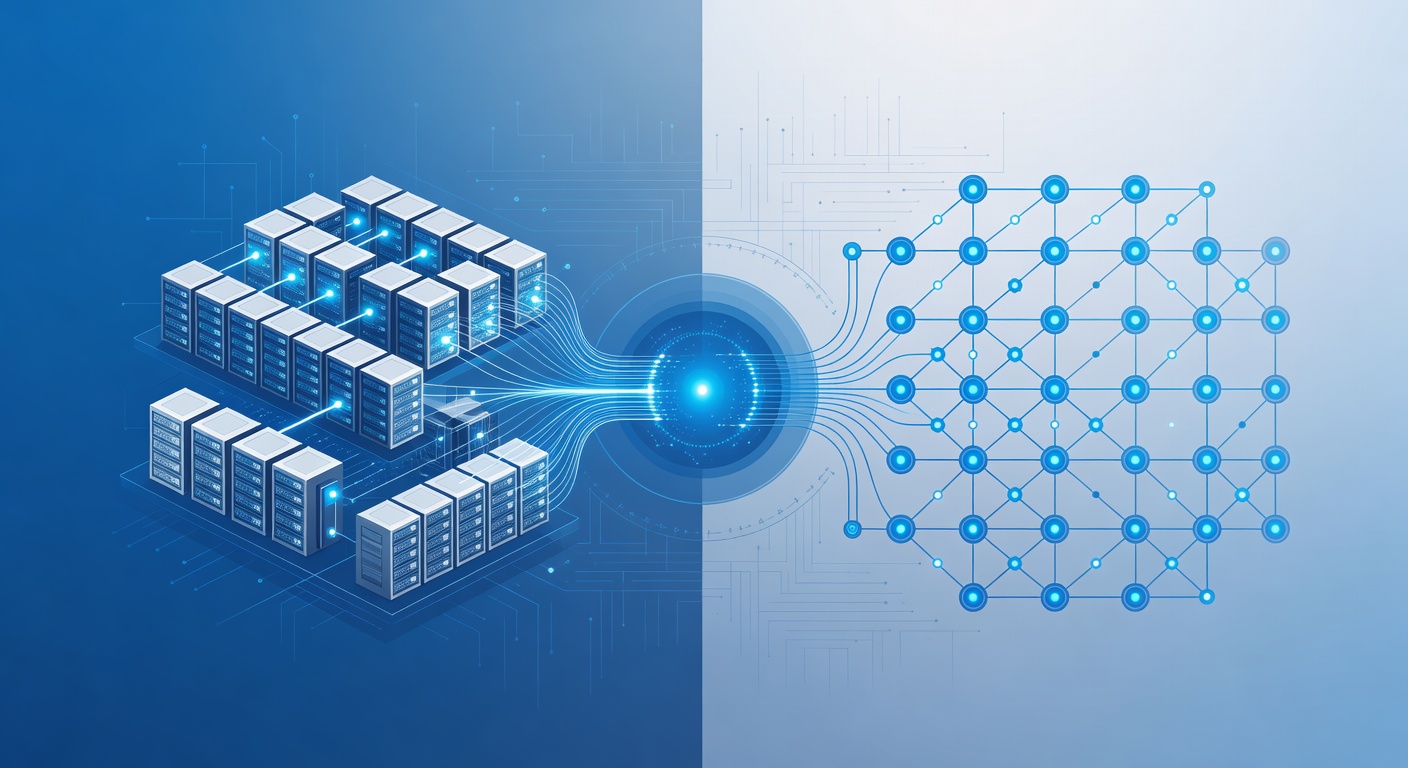
Beyond the Walled Garden: Why We Need to Rebuild the Internet from Scratch
Beyond the Walled Garden: Why We Need to Rebuild the Internet from Scratch
Remember when the internet was supposed to be free?
In 1989, Tim Berners-Lee didn't invent the Web to create platforms where your attention gets auctioned to advertisers. He didn't design HTTP so that a handful of corporations could become the gatekeepers of human communication. Yet here we are—35 years later—watching three billion people navigate a digital landscape controlled by profit-driven incentives that fundamentally misalign with human flourishing.
The Web didn't fail because people are evil. It failed because the system was built with the wrong incentives baked into its DNA.
The Problem Isn't Fixable—It's Foundational
You've probably heard someone say "we need to fix Big Tech" or "we need better privacy regulations." These are well-intentioned proposals. They're also insufficient.
Think about it: How do you patch a system where identity is an afterthought? Where your data is treated as server assets owned by platforms? Where economic incentives flow upward to corporations, not to the creators and participants who actually build value?
You can't regulate your way out of this. You can't add a privacy layer on top and call it solved. The architecture itself is extractive. It's designed to concentrate power, not distribute it.
The only real solution? Build something fundamentally different.
What Does a Better Network Look Like?
Imagine a digital infrastructure built around four non-negotiable principles:
1. Ownership is Absolute You own your identity. You own your data. You own your relationships. Not as a feature that a platform can revoke—but as an architectural guarantee. No company can delete your account. No government can remove you from the network. No algorithm decides what you're allowed to see.
2. Freedom is Structural Censorship shouldn't be prohibited by policy; it should be impossible by design. This doesn't mean consequence-free speech—it means no single authority can silence a voice. The network itself makes suppression mathematically impossible, not just illegal.
3. Truth is Cryptographically Guaranteed Every piece of information on this network is verifiable. You know who said it, when they said it, and whether it's been modified. Truth isn't enforced by moderators or fact-checkers. It's guaranteed by the cryptographic protocols underneath.
4. Access is Universal Not "equal access if you can pay." Not "equal access if your government approves." Equal access period. If it works for anyone, it works for everyone. That's the constraint.
The Architecture Matters
Building this isn't about creating a "decentralized Twitter" or a "blockchain Facebook." Those are just existing systems with different technical plumbing.
Real change requires reimagining every layer:
- Physical Layer: A global mesh where every device is a node, and participants are incentivized to maintain the network itself
- Identity Layer: Cryptographic identities you generate and control, revocable by no one
- Data Layer: Content addressed and user-owned, so your information follows you—not trapped on some company's servers
- Compute Layer: Verifiable computation so you can run programs without trusting the machine running them
- Economic Layer: Value flows to creators, not platform owners
- Interface Layer: AI agents that work for you, not the platform
This isn't theoretical. The technical foundations for this already exist. What's missing is the will to build it comprehensively.
Why Now?
Because we're at a breaking point.
The betrayal is visible. The Web promised freedom and delivered surveillance. We felt it. Many of us built the tools that made it possible. There's a collective recognition that incremental fixes won't work anymore.
The old system was designed to extract value from users. You cannot reform extraction. You can only replace it.
The Opportunity Is Real
Here's what's interesting for developers and builders: In a truly decentralized network, the incentives flip. You build an application? You keep the revenue. You create content? You own your audience directly. You run infrastructure? You earn.
The network belongs to whoever builds it. There's no extraction layer. There's no middleman taking a 30% cut. There's no algorithm deciding your visibility.
For startups especially, this is significant. You're no longer betting on winning the platform's attention algorithm or navigating arbitrary policy changes. You're building on a network with different economic properties entirely.
This Isn't About Technology—It's About Power
Here's the thing: We have the technology to build this. What we need is participation. People running nodes. Developers building applications. Communities establishing norms. Creators publishing directly to audiences.
The network becomes real when it's used. It becomes valuable when people choose it. It becomes unstoppable when enough people understand that ownership—real ownership of your identity, your data, your relationships—is non-negotiable.
The Web promised to liberate humanity. Instead, it concentrated power. We can't patch that. We can only build what comes next.
The question isn't whether a better internet is possible. The question is whether you're going to be part of building it.
At NameOcean, we believe in a web where domains, identity, and data belong to people—not platforms. Vibe Hosting's AI-assisted approach is designed around the principle that your infrastructure should work for you, not extract from you. The future of web architecture is decentralized. The question is how you participate in building it.